The Search Engine Is No Longer a Search Engine: What Every Small Business Owner Needs to Know Right Now
For two decades, the formula was simple: rank on Google, get found, get calls. That formula is being rewritten. 58.5% of U.S. Google searches now end without a single click. ChatGPT has 900 million weekly active users. Google AI Overviews reduce organic click-through rates by 58% for top-ranked content. The businesses that adapt now will own their markets in the AI era. The ones that don't will become invisible.
Editorial Note
This guide is educational. Any workflow examples, operational estimates, or financial illustrations should be validated against your own systems and data; they are not AI Strategy Partners client results or a promise of performance. Where sources are linked, they support the specific external context cited.
The Numbers That Should Concern Every Small Business Owner
58.5% of U.S. Google searches now end without a single click — the user gets an AI-generated answer and leaves without visiting any website. Google AI Overviews reduce organic click-through rates by 58% for content that ranks in position one. ChatGPT now handles approximately 17% of all global digital queries with 900 million weekly active users. 40% of users now start product or service searches with AI tools first, before ever opening a traditional search engine. The pattern is clear: the funnel that small businesses have depended on for twenty years is being restructured from the top down.
How AI Search Actually Works — And Why It Matters for Your Business
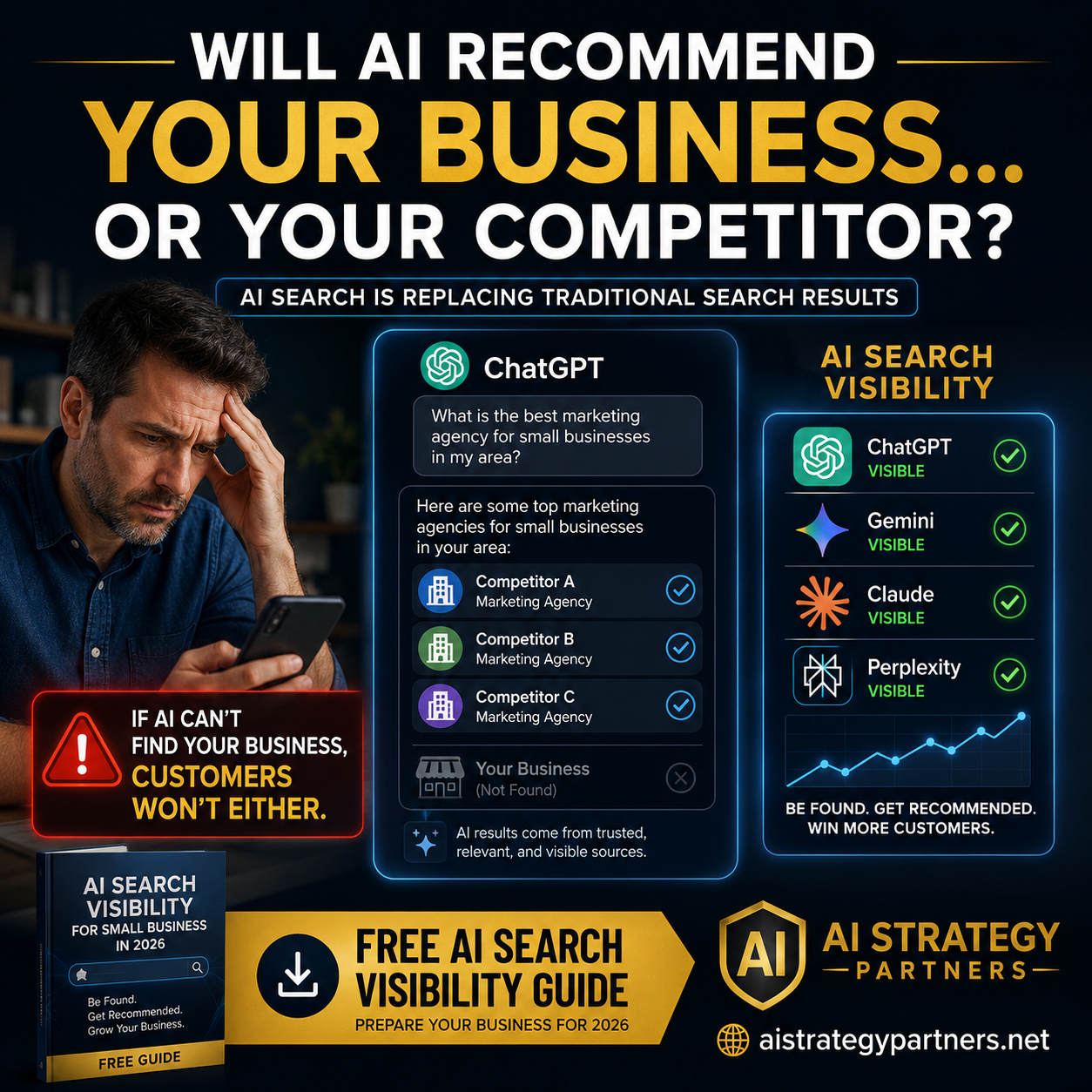
When someone asks ChatGPT 'What's the best HVAC company in Jacksonville?' or asks Google's AI Mode 'Who handles AI automation for local service businesses in Florida?', the AI does not return a list of links. It synthesizes an answer from multiple sources using a technique called Retrieval-Augmented Generation (RAG) — retrieving relevant web pages and using the specific information from those pages to generate a response. The critical implication: if your content is not structured in a way that AI can read, extract, and trust, you will not be cited. You will be invisible in the channel that is growing fastest.
Why Small Businesses Are Especially Vulnerable
Large brands have an inherent advantage: years of authoritative content, thousands of backlinks, and brand names that appear frequently across the web. Small businesses face four structural disadvantages: thin content (most small business websites were built to look good, not to answer questions), no structured data (schema markup is absent from the vast majority of small business sites), inconsistent NAP data (name, address, phone mismatches reduce AI trust signals), and no topical authority (a single service page competes poorly against a business with multiple pieces of content demonstrating deep expertise). The good news: all four are fixable — and most competitors haven't fixed them yet.
What Google Itself Says You Should Do
Google published an official guide to optimizing for generative AI features in 2026. The guidance is direct: SEO fundamentals still apply (AI features are built on top of core ranking systems), create non-commodity content (unique, first-hand, expert perspectives — not generic summaries), optimize your Google Business Profile (GBP is explicitly named as a tool for appearing in AI responses), and ignore the hacks (Google explicitly debunks llms.txt files, content 'chunking,' and seeking inauthentic mentions). The foundation is the same as traditional SEO — but the execution needs to be sharper.
Priority 1: Fix Your Foundation (Week 1–2)
Complete and optimize your Google Business Profile — every field, every category, every service, minimum 10 photos, posting 3x per week. Verify NAP consistency across all directories (your business name, address, and phone must be identical everywhere). Verify your site in Google Search Console and submit your sitemap. These three steps are the non-negotiables — without them, nothing else works as well as it should.
Priority 2: Restructure Your Content (Weeks 2–4)
Add FAQ sections to every service page — minimum 5–8 questions that reflect what customers actually ask, with direct, complete, self-contained answers. Restructure pages to lead with the answer, not build to it. Create industry-specific pages for each of your core industries (e.g., 'AI Voice Agents for Jacksonville HVAC Companies' outperforms a generic 'Services' page). Write from real experience — first-hand, expert content that cannot be replicated by a competitor who hasn't done the actual work.
Priority 3: Add Structured Data (Weeks 3–5)
Implement LocalBusiness schema on your homepage and contact page — this tells AI systems exactly who you are, where you are, what you do, and how to contact you. Add FAQPage schema to your FAQ sections — pages with FAQ schema are significantly more likely to be cited in AI responses. Add Service schema to each service page. Check your current schema at search.google.com/test/rich-results.
Priority 4: Build Authority Signals (Month 2–3)
Earn citations and backlinks from authoritative sources: industry directories (ACCA, PHCC, NARI), local business directories (Chamber of Commerce, BBB), and review platforms (Clutch, Google, Yelp). Get mentioned in third-party content through local news, guest articles in trade publications, and podcast appearances. Generate 4+ new Google reviews per month consistently — AI systems weight recency, not just volume.
The Competitive Window Is Open Right Now
The businesses that will dominate AI search in 2027 and 2028 are the ones building their presence right now, in 2026, while most competitors are still focused entirely on traditional SEO. The cost to build AI visibility is lower now than it will ever be again. The competition for AI citations in most local service categories is minimal. For a Jacksonville HVAC company, a plumbing contractor, or a pressure washing business, the question is not whether AI search will matter to your business. It already does. The question is whether you will be the business that shows up when a homeowner asks ChatGPT who to call — or whether you will be invisible while your competitor gets the recommendation.
Ready to Find Your Revenue Leaks?
Run the free AI Profit Leak Audit to see exactly where your business is losing visibility and revenue in the new AI search landscape. Takes 12 minutes.
Free audit · No credit card · Results in 5 minutes