45% of consumers now use ChatGPT, Gemini, or Perplexity to find local service businesses — and AI search returns one recommendation. If that recommendation isn't your business, you effectively don't exist for that search.
Editorial Note
This guide is educational. Any workflow examples, operational estimates, or financial illustrations should be validated against your own systems and data; they are not AI Strategy Partners client results or a promise of performance. Where sources are linked, they support the specific external context cited.
The Search Engine Has Changed — Most Local Businesses Haven't
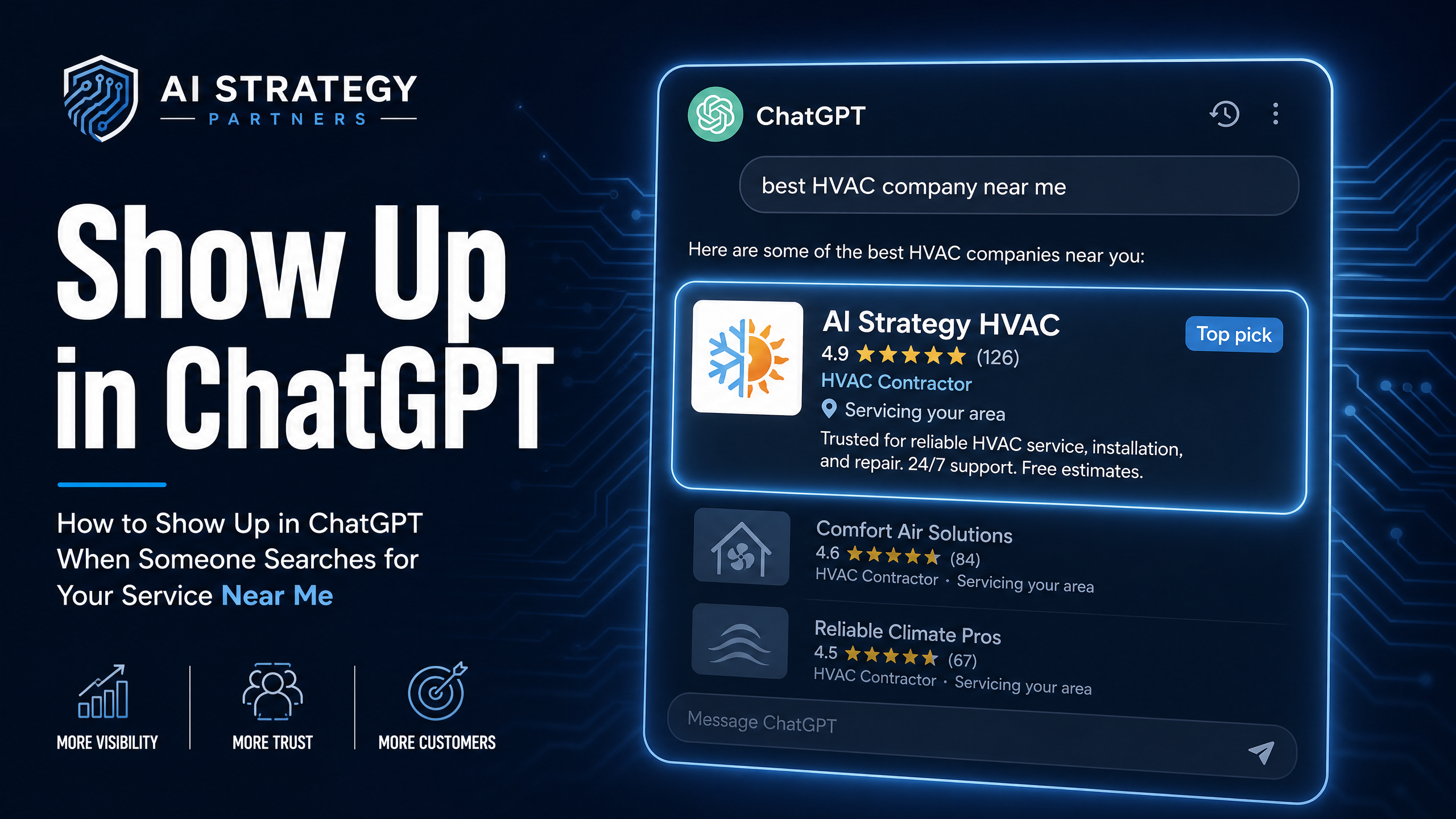
For 20 years, showing up in local search meant ranking on Google's first page. That still matters. But something significant shifted in 2024 and accelerated through 2025: nearly half of all consumers now start their search for local services in an AI chat interface instead of a traditional search engine. They type 'best HVAC company near me in Jacksonville' into ChatGPT, or 'who does emergency plumbing in my area' into Perplexity. The AI gives them one answer — sometimes two. The businesses that don't appear in that answer lose the lead before they ever had a chance to compete. Gartner projects that 25% of traditional search volume will shift to AI engines by 2026. For local service businesses, this isn't a future trend to monitor. It's a present-tense revenue problem.
Why AI Search Works Differently Than Google
Google ranks pages based on hundreds of signals — backlinks, page speed, keyword density, domain authority. AI search engines work differently. They synthesize information from across the web and generate a recommendation based on what they determine to be the most credible, well-documented, and consistently described business. The signals AI engines use most heavily are: review volume and recency (especially Google reviews), consistency of your business name, address, and phone number across the web (NAP consistency), structured data markup (schema) on your website, the quality and specificity of your Google Business Profile, and whether your website answers the specific questions people ask about your service category. The businesses that show up in ChatGPT recommendations are almost always the ones with 100+ Google reviews, a fully optimized Google Business Profile, and a website that answers real customer questions in plain language.
Step 1: Audit and Optimize Your Google Business Profile
Your Google Business Profile (GBP) is the single most important signal for local AI search visibility. AI engines pull heavily from GBP data when generating local recommendations. Start here: make sure your business category is specific (not just 'contractor' — use 'HVAC contractor' or 'residential plumber'). Add every service you offer in the Services section. Write a description that includes your city, your specialty, and the types of customers you serve. Upload at least 20 photos — exterior, interior, team, and job photos. Set your service area to include every zip code you actually serve. Post at least once per week using the GBP Posts feature. Businesses with complete, active GBPs are significantly more likely to appear in AI-generated local recommendations than businesses with sparse or outdated profiles.
Step 2: Build Review Volume and Recency
AI engines treat reviews as a credibility signal. A business with 400 Google reviews and an average of 4.7 stars will almost always outrank a business with 40 reviews in AI recommendations — regardless of how good the website is. The target for most local service businesses is 100+ reviews as a baseline, with new reviews coming in consistently every week. The fastest way to get there is an automated review request system: send a text message to every customer within 2 hours of job completion with a direct link to your Google review page. Businesses that implement this system typically see their review count double within 90 days. Review recency matters as much as volume — AI engines weight recent reviews more heavily than old ones. A business with 50 reviews from the last 6 months will often outperform a business with 200 reviews where the most recent is 18 months old.
Step 3: Add Schema Markup to Your Website
Schema markup is structured data code that tells search engines and AI crawlers exactly what your business is, where it operates, and what services it provides. Most local service business websites have none. This is a significant missed opportunity. The schema types that matter most for local AI visibility are: LocalBusiness schema (your name, address, phone, hours, service area), Service schema (each service you offer with a description and price range), FAQPage schema (questions and answers about your services), and Review schema (aggregate rating from your reviews). Adding schema markup doesn't require a developer — most website platforms have plugins that handle it. But if your website was built on WordPress or a custom platform, a developer can add it in 2–3 hours. The ROI is immediate: schema is one of the clearest signals AI engines use to understand and recommend local businesses.
Step 4: Create Content That Answers Real Customer Questions
AI engines are trained on web content. When someone asks ChatGPT 'how much does it cost to replace an HVAC unit in Jacksonville,' the AI generates an answer based on content it has indexed from websites that answer that question clearly and specifically. If your website has a page that answers that question — with a real price range, a breakdown of what affects cost, and your service area — you have a chance to be cited or recommended. The content strategy for local AI visibility is simple: write one page or blog post for every question your customers ask before they call you. Common examples: 'How much does [your service] cost in [your city]?', 'How long does [your service] take?', 'What should I look for when hiring a [your trade] contractor?', 'What are signs I need [your service]?' Each page should be 500–1,000 words, written in plain language, and include your city name and service area naturally throughout.
Step 5: Build NAP Consistency Across the Web
NAP stands for Name, Address, Phone — and consistency of these three pieces of information across every directory, citation, and website where your business appears is a foundational signal for both traditional local SEO and AI search visibility. AI engines cross-reference your business information across multiple sources. If your name appears as 'ABC Plumbing' on Google, 'ABC Plumbing LLC' on Yelp, and 'ABC Plumbing & Drain' on Angi, that inconsistency reduces the AI's confidence in recommending you. Audit your top 20 citations (Google, Yelp, Angi, HomeAdvisor, BBB, Facebook, Bing Places, Apple Maps, and industry directories) and make sure your name, address, and phone number are identical across all of them. This is a one-time fix that has a compounding effect on your local AI visibility over time.
What This Means for Your Revenue
Local service businesses that implement this 5-step system typically see measurable results within 60–90 days: more calls from customers who say they 'found you on ChatGPT' or 'AI recommended you,' higher Google Maps visibility (because the same signals drive both), and improved conversion rates because customers who arrive via AI recommendation are already pre-sold on your credibility. The businesses that move on this now will own the AI recommendation slot in their market before competitors realize the game has changed. The businesses that wait will find themselves invisible to nearly half of their potential customer base. The cost of inaction isn't theoretical — it's the revenue you're not capturing from the 45% of consumers who are already searching this way.
Ready to Find Your Revenue Leaks?
Find out exactly where your business is losing visibility — and revenue. The AI Profit Leak Audit identifies your top 3 gaps in 12 minutes.
Free audit · No credit card · Results in 5 minutes