How to Use AI to Set Better Prices (And Stop Leaving Money on the Table)
Most small business owners set prices the same way they always have — gut feeling, what competitors charge, or whatever they quoted last time. The problem is that gut-feel pricing almost always means undercharging. According to a 2026 survey by the SBE Council, 65% of small businesses using AI-powered pricing tools report positive revenue impact — with average revenue increases of 8–15% in the first 90 days.
Editorial Note
This guide is educational. Any workflow examples, operational estimates, or financial illustrations should be validated against your own systems and data; they are not AI Strategy Partners client results or a promise of performance. Where sources are linked, they support the specific external context cited.
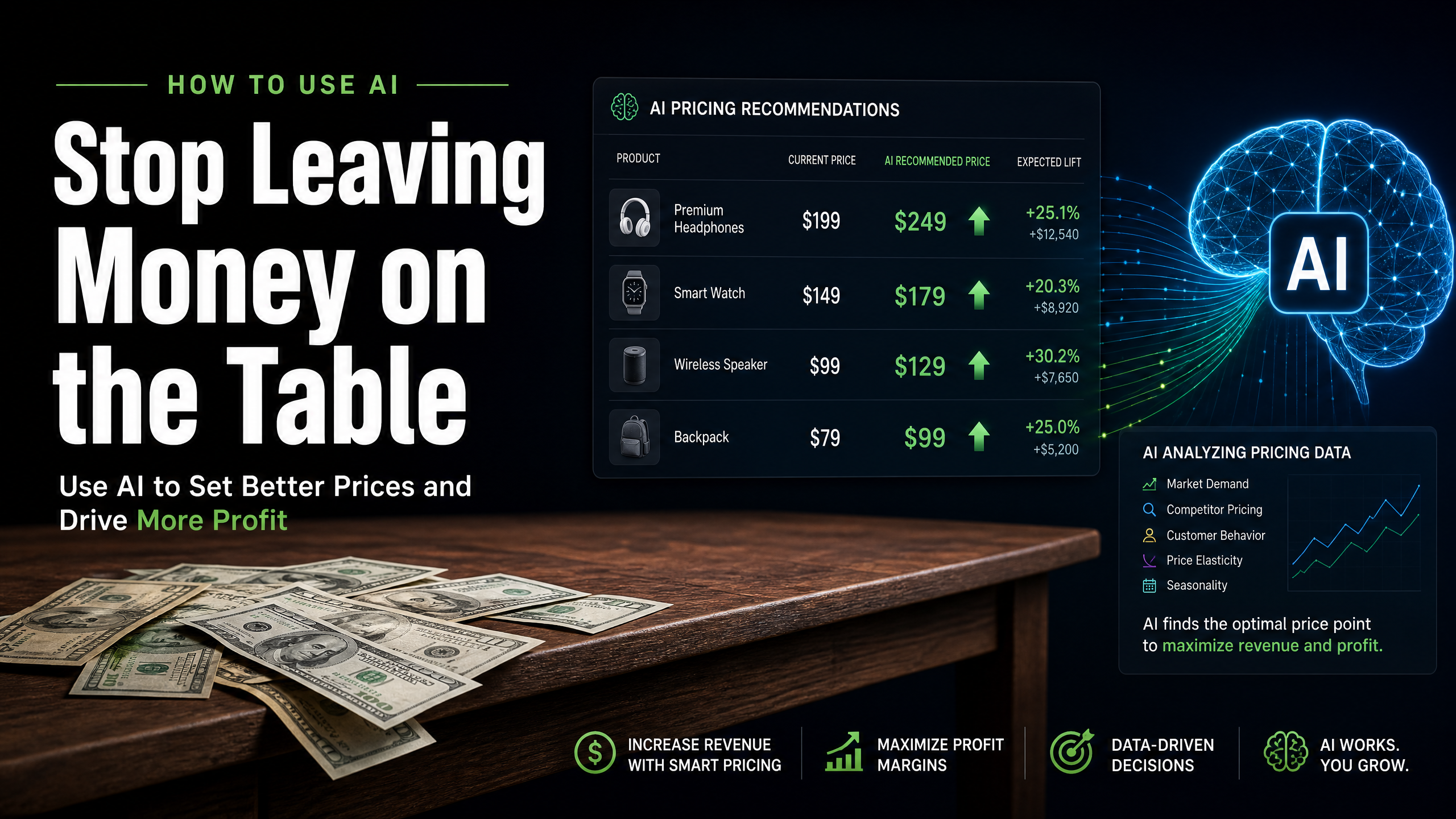
The Real Cost of Underpricing
Underpricing is one of the most common and least-discussed profit leaks in small business. When you charge $150 for a job that the market will bear $195, you don't just lose $45 on that job — you lose $45 on every similar job you do for the rest of the year. For a business doing 20 jobs per week, that's over $46,000 in annual revenue left on the table from a single pricing gap. The problem isn't that owners don't want to charge more. It's that they have no reliable way to know what the market will actually pay. AI pricing tools solve this by analyzing competitor pricing, demand signals, seasonal patterns, and job complexity to recommend optimal price points in real time.
What AI Pricing Actually Does
AI pricing tools work by ingesting data — your historical jobs, local competitor rates, demand patterns, and customer behavior — and using that data to surface pricing recommendations. For service businesses, this typically means: dynamic job pricing (adjusting quotes based on demand — emergency calls command premium rates; off-peak slots can be discounted to fill the schedule), upsell identification (flagging jobs where customers historically accept add-ons), margin protection (alerting you when a quote is below your actual cost-per-job threshold), and competitive benchmarking (showing you where your prices sit relative to the local market).
The Hidden Lever: Demand-Based Pricing
One of the most underused AI pricing strategies for service businesses is demand-based pricing — charging more during peak demand periods and less during slow periods. HVAC companies that charge a premium for emergency calls and weekend service, and offer a discount for scheduled maintenance during their slow season, consistently outperform competitors who charge flat rates year-round. AI tools can automate this entirely: when a call comes in at 9pm on a Friday, the system automatically quotes the after-hours rate. When the schedule is empty on a Tuesday afternoon, it offers a same-day discount to fill it.
Tools Worth Knowing
For service businesses, the most practical entry points are tools that integrate with your existing CRM or job management software. Jobber and ServiceTitan both have built-in pricing intelligence features. For businesses not on those platforms, tools like Prisync and Competera offer standalone pricing analytics. At the simplest level, even a well-structured ChatGPT prompt can analyze your job history and suggest where you're undercharging — try: 'I run an [industry] business in [city]. Here are my average prices for these job types. Where am I likely undercharging based on typical mid-tier market rates?'
How to Find Your Pricing Gap This Week
Pull your last 90 days of completed jobs, sort them by job type, and calculate your average price per job type. Then run the ChatGPT prompt above. From there, a 10% price increase on your three most common job types — tested on new customers first — is typically enough to generate a measurable revenue lift within 30 days without losing existing clients. Pricing is the highest-leverage financial lever in your business. A 10% price increase on existing volume costs you nothing in labor or materials — it goes straight to the bottom line.
Ready to Find Your Revenue Leaks?
Underpricing is one of the seven profit leaks we diagnose in the AI Profit Leak Audit. Take the free audit to see exactly how much your pricing gap is costing you — and get a custom action plan.
Free audit · No credit card · Results in 5 minutes