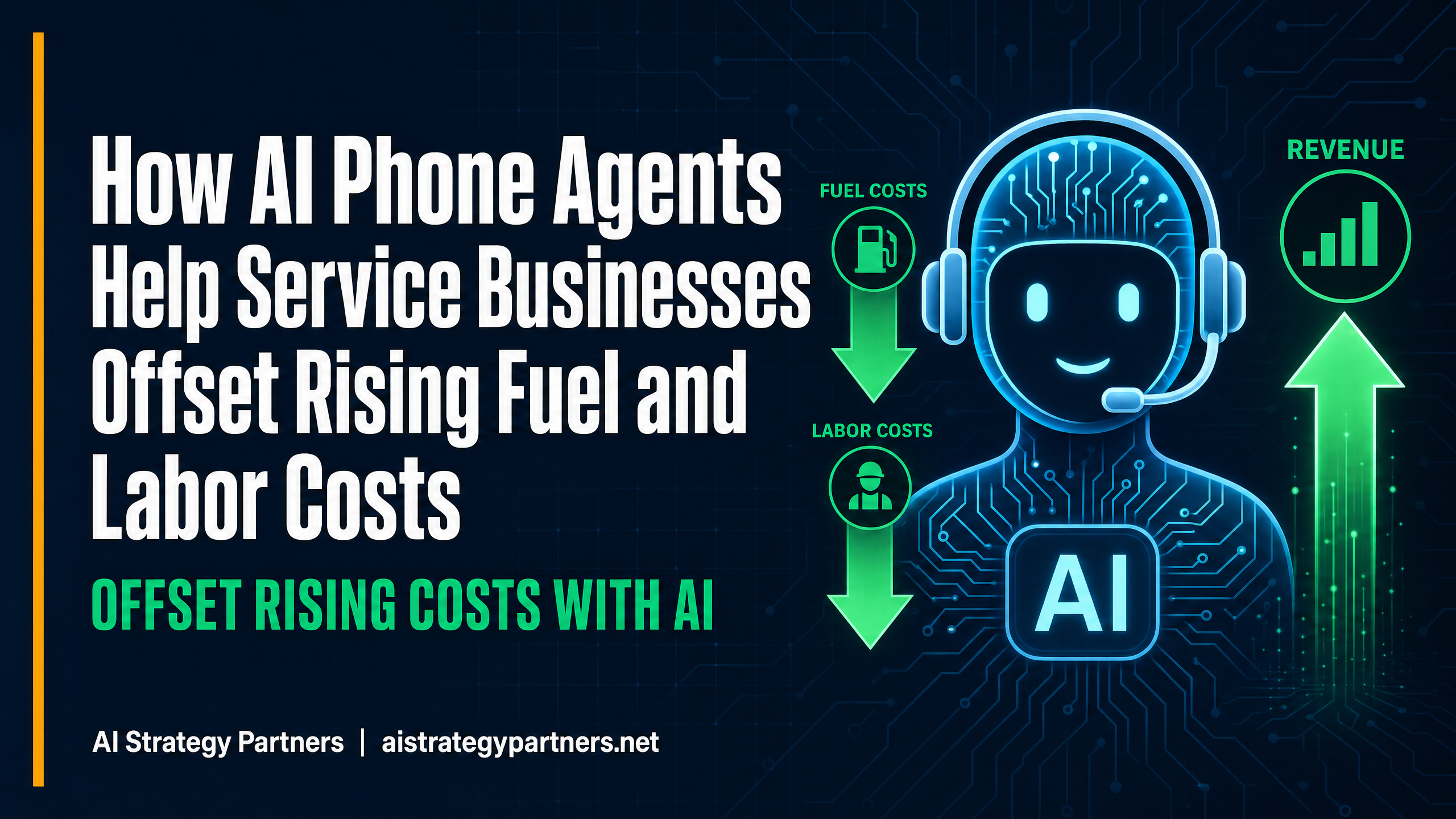
Every unqualified truck roll costs fuel, technician time, and job capacity. AI phone agents reduce this waste by qualifying leads before dispatch, confirming appointments before trucks roll, and capturing after-hours calls that would otherwise be missed. The result is fewer wasted miles, more profitable jobs, and lower labor cost per completed appointment.
Editorial Note
This guide is educational. Any workflow examples, operational estimates, or financial illustrations should be validated against your own systems and data; they are not AI Strategy Partners client results or a promise of performance. Where sources are linked, they support the specific external context cited.
The Unqualified Dispatch Problem
When a service business dispatches without qualifying the lead, it risks sending a technician to a job that is out of service area, outside the business's scope, or not ready to book. Each unqualified truck roll costs an average of $45–$85 in fuel and technician time, depending on distance and vehicle type. A business that dispatches 5 unqualified jobs per week is spending $11,700–$22,100 per year on trips that produce no revenue. At elevated fuel prices, the cost per unqualified dispatch increases proportionally.
How AI Phone Agents Qualify Before Dispatch
An AI phone agent answers every inbound call and asks the qualification questions the business defines: What type of service do you need? What is your zip code? Is this an emergency or a scheduled appointment? Are you an existing customer? Based on the answers, the agent either books the appointment directly, routes the call to a human for complex situations, or captures the lead for follow-up. Jobs that do not meet the qualification criteria are flagged before a truck is dispatched.
After-Hours Call Capture: The Fuel-Cost Offset
For HVAC, plumbing, and emergency service businesses, a significant portion of high-value calls come in after business hours. A business that misses 5 after-hours calls per week at an average job value of $1,200 is losing $312,000 per year in potential revenue. An AI phone agent captures these calls, qualifies the need, and either books the appointment or alerts the on-call technician for genuine emergencies. The revenue recovered from after-hours capture often exceeds the total annual fuel cost increase from a price spike.
Appointment Confirmation: Preventing the Wasted Roll
AI phone agents and CRM automation can send appointment confirmations and reminders automatically — reducing no-show rates by 30–50%. For a business running 20 appointments per week with a 15% no-show rate, that is 3 wasted truck rolls per week. At $65 average cost per roll, preventing those no-shows saves $10,140 per year. The fuel savings alone justify the cost of the automation system in most cases.
ROI: The Combined Effect
The strongest return from AI phone agents comes from combining three effects: fewer unqualified dispatches, more after-hours revenue captured, and fewer no-shows. For a mid-sized service business, the combined annual value of these three improvements typically ranges from $40,000 to $120,000 — depending on call volume, average job value, and current miss rate. The system cost is typically $300–$800 per month. The payback period is usually less than 30 days.
Ready to Find Your Revenue Leaks?
Missed calls, unqualified dispatches, and no-shows are three of the seven profit leaks we identify in the AI Profit Leak Audit. Book the free audit to see exactly how much these issues are costing your business — and what an AI phone agent would recover.
Free audit · No credit card · Results in 5 minutes
More in the Fuel & Operating Costs Series
Why High Gas Prices Are a Warning Sign for Small Business Operations
7 min readPricing StrategyHow to Calculate a Fuel Surcharge for Your Small Business
6 min readOperationsRoute Optimization for Service Businesses to Cut Fuel Costs
7 min readProfit ProtectionThe AI Profit Protection Plan for Gas Price Spikes
8 min read